

Your surgery day. Our team in your corner.
Keep your digital full-arch cases moving with coordinated planning, dedicated design support, and direct communication throughout surgery day.
Power Dental Studio works alongside your surgical and restorative teams to review records, prepare designs, verify implant-position data, and coordinate fabrication. From the first upload to the surgical temporary, every stage is organized around the details of your case.
A smoother surgery day starts before surgery
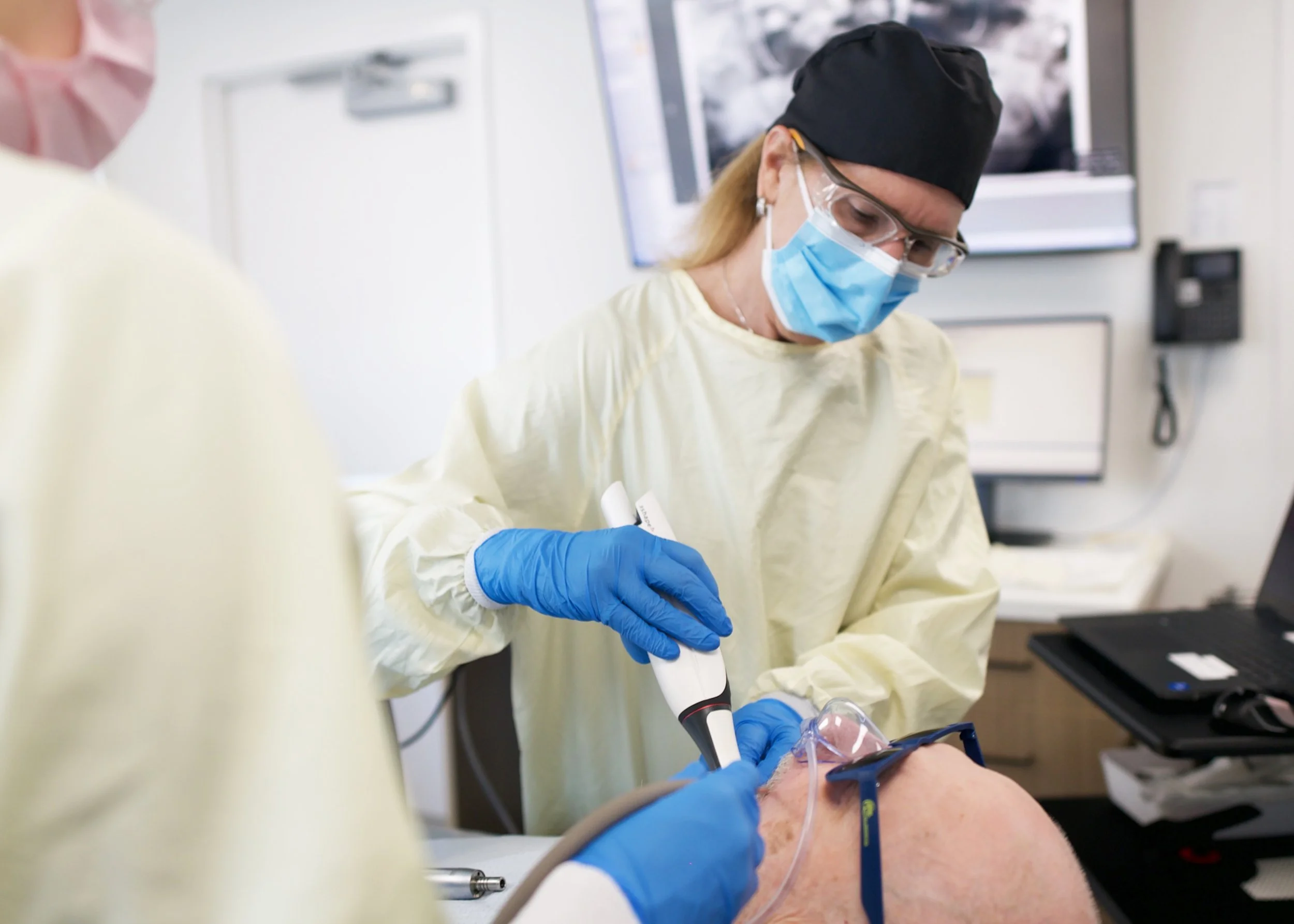
Your workflow begins when we receive your patient records and prescription. Our team reviews the information, identifies potential concerns, and prepares a preliminary digital tooth setup for your doctor’s review.
Before surgery, we align on the intended restorative outcome, components, scanning protocol, and production plan. On surgery day, your clinical team captures the required records while our designers and clinical support team help keep the process moving.
Once the necessary records have been received and verified, we complete the surgical temporary design and coordinate the next step: printing in your office or fabrication through Power.
Same-day restoration workflows depend on complete records, timely communication, production availability, and the treating doctor’s assessment of clinical suitability.
Your surgery-day workflow, step by step
01
Submit records and confirm the plan
Upload your prescription and digital records through the Power Dental Studio portal. We review your submission for completeness, usable scan data, and instructions before design begins.
Please provide:
Intended surgery date.
Upper and lower intraoral scans with an accurate bite relationship.
Prescription and restorative instructions.
Planned multi-unit abutment brand, prosthetic components, and screw type.
Desired design style and occlusal scheme.
Intended surgical and scanning workflow.
Planned fabrication material and production location.
Patient photographs, recommended for esthetic planning.
CBCT files when applicable, including cases involving preplanned implant placement.
Our designers import and align the records, check scan orientation and bite relationships, and contact your office if anything is missing or inconsistent. Additional scans may be needed before the case can proceed.
02
Meet your designer and prepare the tooth setup
Each same-day design case has a dedicated designer, supported by design supervisors and our clinical support team.
Before surgery, our preliminary planning team, known as Stage 0, reviews the submitted records and creates a digital wax-up based on your instructions. We evaluate existing tooth positions, the recorded vertical dimension, patient photographs when provided, and the intended restorative outcome.
Office preferences are stored in our portal and carried into each submitted case. Case-specific instructions help us account for changes in components, tooth arrangement, or clinical approach.
Your team can communicate with the designers through Slack to share updates, clarify instructions, and request revisions.
03
Capture surgery-day records and verify alignment
Your scanning protocol includes a stable reference that allows the preoperative and postoperative records to be aligned.
Depending on the agreed workflow, this may be a designated bone screw, retained teeth, or existing implant sites. The reference must remain stable throughout surgery and be fully visible in the required scans.
Our team reviews the implant-position records alongside the postoperative intraoral scans and, when provided and applicable, CBCT data. Where supported by the capture system, we also use its associated software to assess alignment and identify potential inconsistencies.
Photogrammetry provides implant-position data that can be combined with intraoral scans of the surrounding anatomy to support the full-arch design.
If records do not align as expected, we contact your team through Slack and/or phone. Some questions can be resolved by clarifying instructions or reviewing existing files. Suspected implant-position discrepancies may require new clinical records before we proceed.
04
Review the design and coordinate production
Before release, our quality-control designers and team leads review the case, including the design, selected components, and submitted records.
If your doctor requests final design approval, we share the case for review through the exocad design viewer. Your team can request changes before fabrication. For cases proceeding without a separate doctor approval step, our internal quality-control review still applies.
Before production, the restoration material and intended prosthetic screws must be confirmed.
Fabrication options include:
Printed resin temporaries
The primary option for surgery-day temporary workflows.
Milled PMMA temporaries
A more rigid option for longer-term provisional needs, with additional production time.
Approved designs can be sent to your office for printing or transferred to Power’s production team. For lab-fabricated cases, a dedicated coordinator manages the handoff to printing, finishing, quality control, and shipment.
Timing that supports your surgery-day plan
15 Min
Stage 2 record alignment checks
30 Min
Day-of-surgery design turnaround
The full case schedule also includes clinical record capture, any necessary corrections, doctor review, fabrication, post-processing, and delivery arrangements.
| Workflow milestone | What to expect |
|---|---|
| Before surgery | Record review, preliminary design, component confirmation, and workflow coordination. |
| Surgery-day verification | Review and alignment of the required clinical records. |
| Design completion | Completion of the surgical temporary design after the necessary records are available and usable. |
| Approval and fabrication | Required approvals followed by in-office printing or Power’s production process. |
| Delivery | Timing based on fabrication location, material, production requirements, and shipping when applicable. |
For lab-fabricated surgical temporaries, required scans must arrive within the applicable surgery-day submission window to support same-day fabrication and shipment. Confirm that deadline with our team before scheduling.
Missing records, rescans, design revisions, delayed approvals, component questions, and material selection can affect turnaround. If the planned timeline changes, we contact your office to establish updated expectations.
Same-day shipment and same-day patient delivery are separate milestones. Your team should confirm the production and delivery plan for each case.
Direct communication when your team needs it
Your clinical team can contact Power’s Clinical Liaison with workflow questions and coordination needs. Your assigned designer and design team leads are also available to support the case.
Most surgery-day communication takes place directly through Slack. When an urgent question or record discrepancy needs attention, we also contact your office by phone.
Our team maintains an active case log to track incoming records, design progress, and outstanding questions. If essential information is missing, we alert your team promptly so it can be addressed.
Your surgeon, restorative doctor, and support staff work with a coordinated Power team that includes designers, clinical support, production coordinators, printing and finishing technicians, quality control, and customer service.
Small details can make a big difference.
The most common workflow interruptions include unclear prescriptions, incomplete bite records, missing case instructions, and difficulty reaching the doctor or clinical team. Preparation helps your case move more efficiently.
Confirm the bite.
Provide upper, lower, and bite scans that accurately record the intended relationship.
Include supporting records.
Provide photographs and CBCT files when relevant to the treatment plan.
Share the restorative plan.
Document the desired tooth arrangement, esthetic preferences, occlusal scheme, and any clinical limitations.
Plan your reference scans.
Agree on a stable reference and scanning sequence before surgery begins.
Identify the components.
Confirm the multi-unit abutment system, screw type, and fabrication material before production.
Keep a contact available.
Make sure a designated team member can respond to questions during verification, design, and approval.
Flexible records. Connected design. Coordinated fabrication.
Our workflow brings digital records, design software, and manufacturing together around your case.
Intraoral scans
We accept STL and PLY scan files. Your intraoral scanner must be able to export the required records in a usable format.
Printing and milling
Power uses SprintRay and Carbon printers for temporary restorations. Milled PMMA provisionals are also available with a longer turnaround.
Photogrammetry and related capture workflows
Supported workflows include iCam, PIC, Micron Mapper, Shining 3D, OptiSplint, Nexus, Blue Sky Bio, and TruAbutment. Confirm the required export files and supporting records with our team for your specific system.
Quality control
Our process combines record alignment, cross-checking of available clinical data, component review, design evaluation, and fabrication inspection.
Digital design
We primarily use exocad for full-arch prosthesis design and digital wax-ups. Doctors can review shared designs through the exocad design viewer.
A custom temporary with a coordinated digital workflow
A conversion-denture approach can involve adapting an existing denture during surgery and connecting it to temporary components.
Power’s digital workflow starts with a patient-specific tooth setup, then incorporates the required surgery-day records to design a custom temporary for the planned multi-unit abutment configuration.
For equipped practices, the design can be transferred directly to the office for printing. Practices using Power’s fabrication services receive coordinated production support.
What makes the workflow different:
A dedicated designer for each same-day design case.
Preliminary planning before surgery.
Office preferences carried into each case.
Direct communication with design and clinical support.
Digital record checks before fabrication.
In-office printing and laboratory fabrication options.
Frequently asked questions
Questions about an upcoming case? Call (331) 777-5160.
-
At minimum, we need upper and lower intraoral scans, an accurate bite relationship, and a prescription with the case instructions. Provide the surgery date, planned components, screw type, and intended workflow. Photographs are recommended, and CBCT files should be included when applicable.
Surgery-day records must follow the agreed scanning protocol, including the stable reference needed for alignment.
-
Yes. We accept records from multiple photogrammetry and related capture systems. Contact our team to confirm the export package and supporting scans required for your equipment.
-
Contact Power as soon as the intended surgery date is known. This gives both teams time to review records, prepare the preliminary design, and confirm the scanning and fabrication plan. Our team will confirm scheduling availability and submission requirements for your case.
-
Yes. Our Clinical Liaison and design team communicate directly with the doctor and designated clinical staff through Slack and phone as needed.
-
We notify your team and explain what needs clarification or verification. Depending on the issue, we may need revised instructions, additional files, or new clinical scans before proceeding.
-
Yes. If requested, we share the design for doctor review through the exocad design viewer. Let us know your approval preference during case planning.
-
Yes. Designs can be sent to your office for printing when that is the agreed production workflow. Power can also fabricate and ship the temporary.
-
Key factors include clinical suitability, complete and usable records, timely approvals, component confirmation, material selection, printing availability, and the fabrication and delivery plan.
Your treating doctor determines whether same-day delivery is appropriate for the patient.
-
Submit complete records before surgery, confirm components and materials, follow the agreed scanning protocol, and keep a designated contact available for questions and approvals.
Let’s get Your Team Ready For Surgery Day
Connect with Power Dental Studio to review your upcoming case, confirm record requirements, and coordinate design and fabrication.